The Truth About Your MyAir Scores: What ResMed Isn’t Telling You
Let’s talk about the MyAir app from ResMed, which many CPAP users rely on for feedback on their sleep therapy. While the app’s designed to be user-friendly and reassuring, it’s potentially doing more harm than good, especially for people who rely on it for accurate results.
The Illusion of “Excellent” Scores
The issue with MyAir is that it offers overly positive feedback, even when it may not reflect your true sleep health. For example, one user shared their results on a Facebook group, where the MyAir app showed an “excellent” score, even though their AHI (Apnea-Hypopnea Index) was 16. An AHI of 16 is considered moderate sleep apnea, not excellent, which leads to the question: how reliable is this app?
The Problem with MyAir’s “Everyone’s a Winner” Mentality
MyAir gives you a score that looks good, but it doesn’t accurately reflect your therapy’s effectiveness. For instance, in this example, the app says the results are excellent when, in fact, they are far from it. This can mislead users, making them think their treatment is on track when it actually needs adjustment. This is why we need to look beyond the app’s feedback.
How Accurate Is ResMed’s Events Per Hour (AHI)?
Less accurate than it looks, according to the research below: the ResMed AirSense 10 often underestimated AHI, the events per hour your machine reports, so a night it scored at 16 could have been closer to 25–30. In a study where simulated breathing data was analyzed by both CPAP machines and top respiratory physicians, the machines often gave results that did not match the actual severity of sleep apnea.
For example, when testing the ResMed AirSense 10 (a popular CPAP machine), the data showed that the machine’s AHI scores were often underestimated. If the device scored an AHI of zero, it could actually be closer to a 10, and if it showed a 16, it could have been more like 25-30. This discrepancy reveals a significant issue—while your machine might show a “great” score, it could be masking a much bigger problem.
Comparing CPAP Machines and Their Accuracy
Let’s dive into how different CPAP machines performed in this research:
-
ResMed AirSense 10: One of the most widely used machines, but it often underestimates AHI. The data showed that it could score a 10 or 16 when it should have been higher.
-
Philips DreamStation: Surprisingly, this machine did a better job at accurately reflecting AHI. While it might not be the best at lowering AHI, it at least gives an honest score.
-
SBox (CFAM): This French company’s device scored somewhere between the AirSense 10 and DreamStation, with moderate accuracy.
-
Löwenstein prisma20A: This machine performed the best, showing highly accurate results similar to the DreamStation.
Hypopneas: The Hidden Issue
Most of the discrepancy in the CPAP machines’ performance comes from hypopneas, which are medium reductions in breathing. While apneas (complete blockages of the airway) are typically flagged correctly, hypopneas often go unflagged, leading to an underestimation of how severe someone’s sleep apnea really is.
For example, with ResMed’s AirSense 10, it might mark hypopneas as “normal” when, in reality, they are causing significant disruptions to sleep. These missed hypopneas can prevent accurate diagnosis and treatment adjustments.
The Role of Blood Oxygen Levels
The best way to evaluate your CPAP therapy’s effectiveness is by looking at your blood oxygen levels. If your oxygen levels are stable and high, your therapy is likely working as it should. If they’re fluctuating or low, this is a sign that your therapy needs adjustment.
Conclusion: Trust Your Oxygen Levels, Not the MyAir Score
While the MyAir app might give you an “excellent” score, the truth is that your AHI might be higher than it seems. The most reliable indicator of effective sleep therapy is your blood oxygen levels. If you’re still feeling tired despite high scores, it might be time to dig deeper and adjust your therapy for better control over your sleep apnea.
Common Questions About MyAir
What does a good MyAir score actually mean?
It means MyAir rated your night well, not that your sleep apnea was under control. In the example above, MyAir called a night “excellent” when the AHI was 16, which is moderate sleep apnea. Treat the score as a summary, and go through the detail underneath it — your AHI and, ideally, your blood oxygen — with your doctor or sleep specialist.
How does MyAir compare to other CPAP tracking apps?
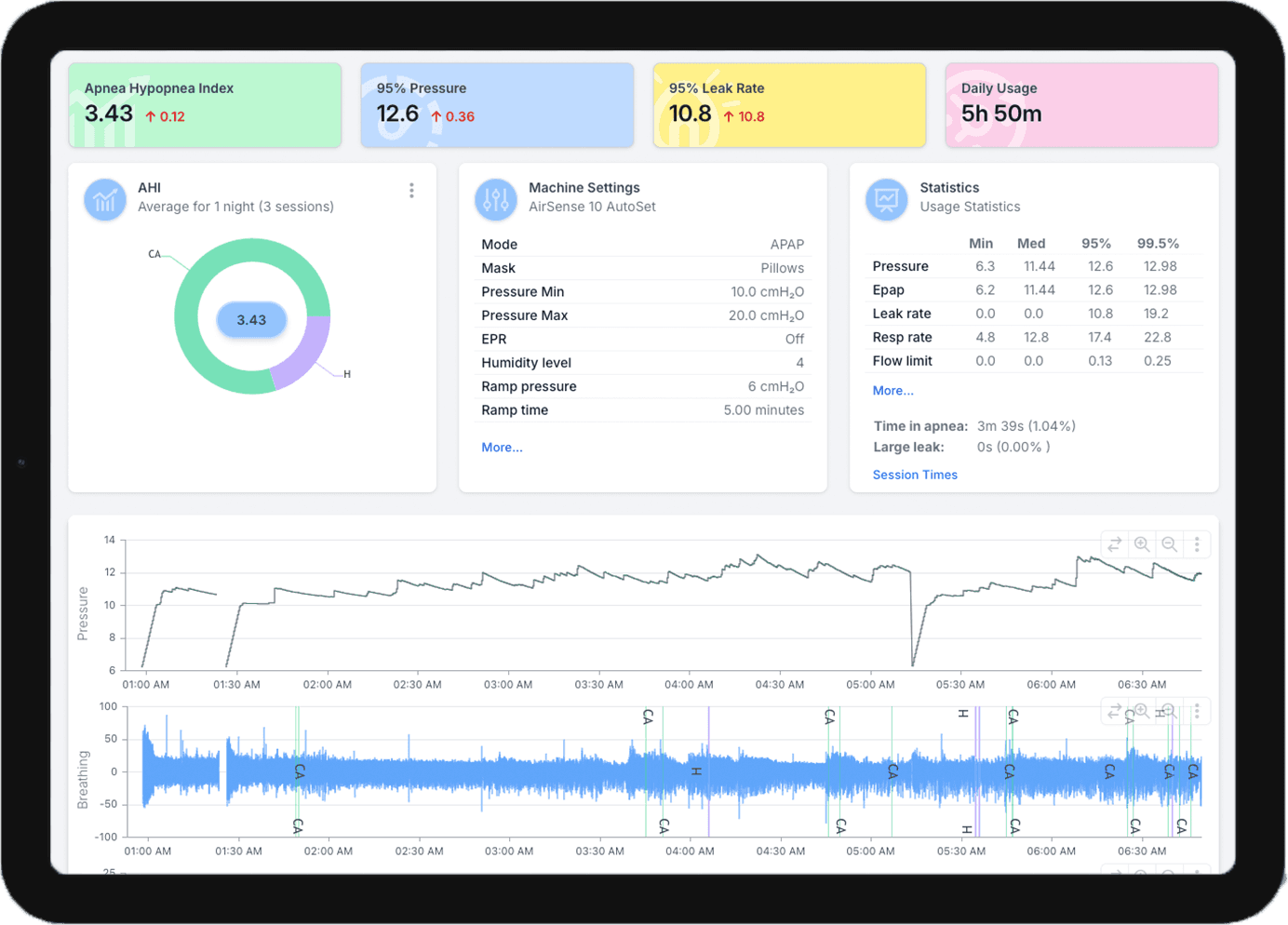
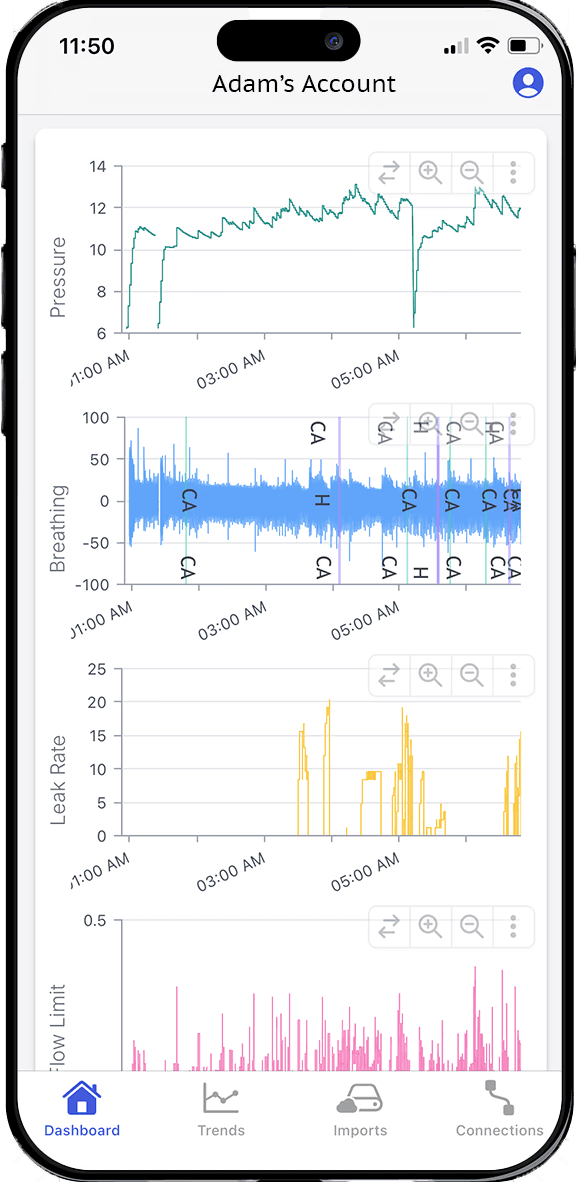
MyAir gives you a nightly score and a short summary; SleepHQ reads the full data your machine records to its SD card. Every night comes in with usage hours, AHI, pressure, leak rate and respiratory rate, and flow limitation on machines that record it, with the detailed charts underneath them and breath-by-breath analysis, so you can see when in the night something happened rather than a single number for the whole of it. SleepHQ also reads machines from Philips Respironics, Fisher & Paykel, Löwenstein and BMC as well as ResMed — see every supported machine.
Is MyAir useful if I’m just starting CPAP?
As a quick nightly check-in, yes, but not as the verdict on whether your therapy is working, because its score can call a night excellent when it was not. A free SleepHQ account reads the files on your machine’s SD card and shows your most recent 30 days breath by breath, and you can send your doctor or sleep specialist a share link to the same nights. SleepHQ shows you your data; it does not recommend therapy settings.
What can I do when MyAir says last night’s data isn’t available yet?
If your machine records to an SD card, you can still see the night: SleepHQ reads it from the card, not from MyAir. Copy the card’s files and upload them to SleepHQ from a computer or a phone with a card reader, or, on a ResMed series 10 or series 11 machine, let a Magic Uploader Pro send each night to SleepHQ overnight. The Magic Uploader Pro requires a SleepHQ Pro membership.

Nick Dunn
SleepHQ Founder